Tiles & Tribulations
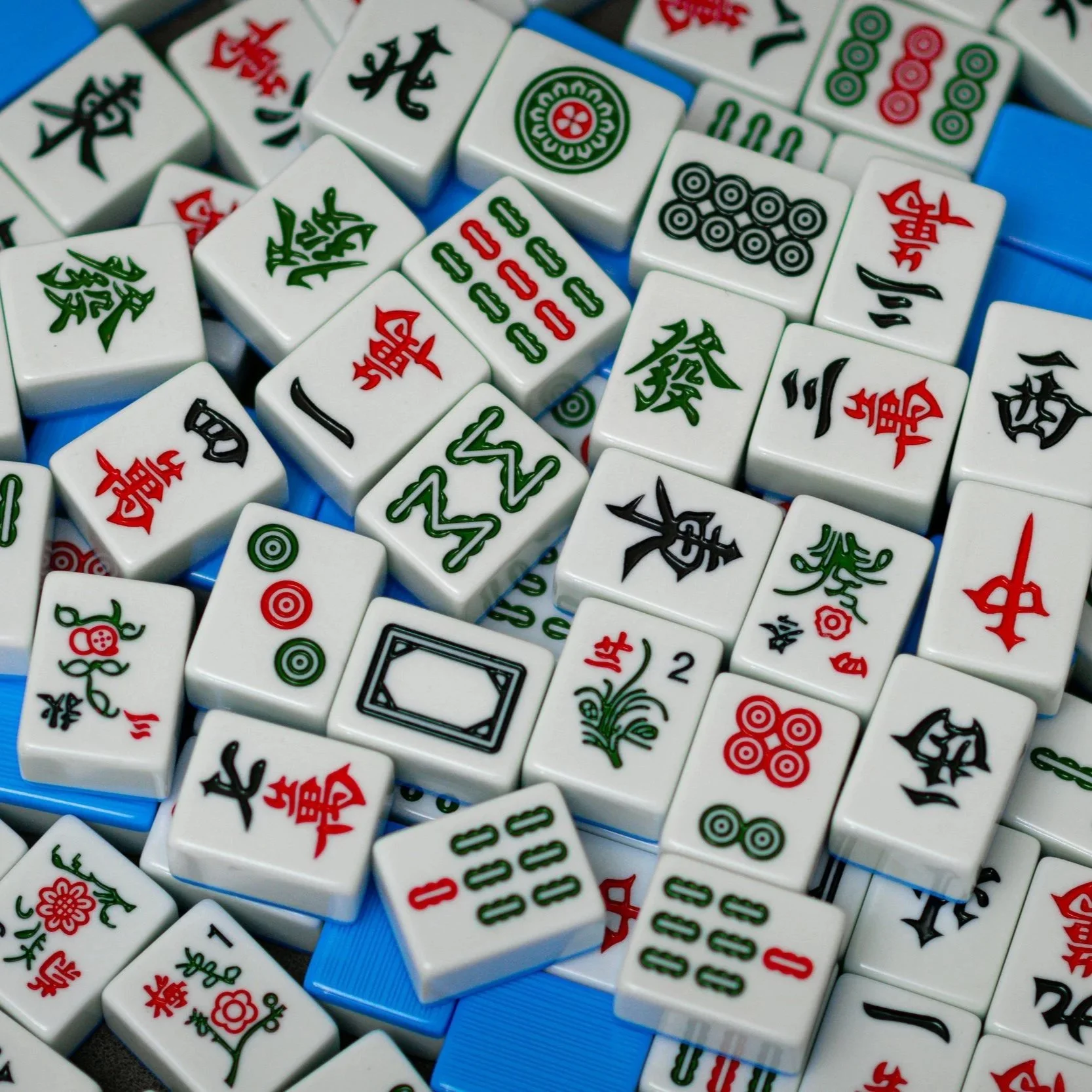
At sixty years old, living in Florida for the winter, it will surprise exactly no one to hear that I have surrendered to mahjong. I hardly had a choice in the matter: It’s a law down here. Crossing the bridge into Miami Beach, visitors are mandatorily gifted a pickleball visor, a stone crab and a mahjong set. I am just one of many eager participants ready to click-clack their way through an afternoon.
For the uninitiated, mahjong’s goal is to achieve a prescribed combination of tiles using your best decisive powers to determine which tiles to keep and which to discard. It is a game of tough choices and, more than anything else, it is a game of rules. Pairs are subject to one set of regulations, consecutive tiles another. Dealing is done with the solemnity and precision of a papal succession. I pity the novice who doesn’t deal in an Easterly direction using only one hand, and Lord have mercy on the gal who touches another player’s Joker without permission. [I learned the hard way.]
Such a regimented game might be a turn-off to some, but I couldn’t love it more. For those like me who struggle with the easiest decisions -- sparkling or flat, aisle or window, Pitt or Cooper -- I live for the environment where ritual rules the day, the stakes are low, and questions are not encouraged. Why only one hand when dealing? Shut up, Alice.
It’s mahjong’s way or the highway and if you think I’m kidding, I invite you to play with Lorraine from Cedarhurst, a leather handbag of a human being who will bite your hand to the bone if you try and call for a tile she’s already racked. Lorraine is my sun, my moon, and my star.
Unlike Lorraine, I am someone who doesn’t have the fortitude to ask people to remove their shoes off before coming into my home. Even when I feel my throat closing, I can’t bear tell a friend she’s wearing too much perfume. I suffer in silence when people double dip, and I breezily laugh off your lateness without ever revealing the terrible things I wished upon you while I waited.
But the ritual of mahjong allows me to unleash my most direct self. I am fueled by the stern construct of the game to say the things I could never say in the outside world: Move it along, Betsy. Too late, Lisa. Your hand is dead, Denise. While in real-life I am spinning about every life choice, and cower from every confrontation, mahjong is all tile, zero tribulation.
It is true story that I picked my wedding cake by randomly opening up to a page in the very thick catalog at Katherine’s Bakery because I could simply not make one more wedding-related decision. I picked the first cake on the page I opened to because that was easiest, even if it was a carrot cake swathed in orange satin ribbon. I just didn’t have the wherewithal to contemplate other ribbons or frostings or other cakes. That feeling of being overwhelmed by too many choices is ever-present these days. Give me prix fixe menus, work uniforms, thematic dress codes and assigned seats.
Or just give me mahjong. I love the game, not just for its respite from reality, and limited choices, but for the comraderie. It’s more than women vying for a win; it’s women vying for one another. [Except, Lorraine.] I’m delighted to spend time in a world where I can revel in the tiny thrill of choosing correctly, among choices that are pre-ordained, without ever the risk of being wrong or making anyone hurt or sad. Because that’s a win. Or, as we say at the table, Mahjong.
Double-click to edit...